Binary Search Trees: Operations & Efficiency
A standard binary tree is just a structural shell. A Binary Search Tree (BST) is a functional powerhouse because it enforces an ordering rule. This rule turns a simple branching structure into a high-speed engine for searching and sorting.
In this lecture
- The BST Property: The logic that makes $O(\log n)$ possible.
- Key Operations: How to search, add, and remove without breaking the tree.
- Traversals: Navigating the tree to extract sorted data.
- The Balancing Problem: Why sorted input is a BST's worst enemy.
1) The BST Property
To be a BST, every single node must follow this rule:
- Left Subtree: All values must be less than the parent.
- Right Subtree: All values must be greater than the parent.
The Logic:
Notice: Every node to the left of 10 is smaller than 10; every node to the right is larger. This applies recursively to every subtree (e.g., 2 and 7 are correctly placed relative to 5).2) Key Operations
Search & Access

In an array, you have to check every element ($O(n)$). In a BST, you cut the search area in half at every step ($O(\log n)$).
Example: Find 7 1. Start at 10. $7 < 10$, so go Left. 2. Arrive at 5. $7 > 5$, so go Right. 3. Arrive at 7. Found.
Add (Insertion)

You don't "force" a node into a specific spot. You follow the search logic until you hit a null gap—that is where the node belongs.
Example: Insert 13
Remove (Deletion)
Deletion is the most complex operation because you have to stitch the tree back together.
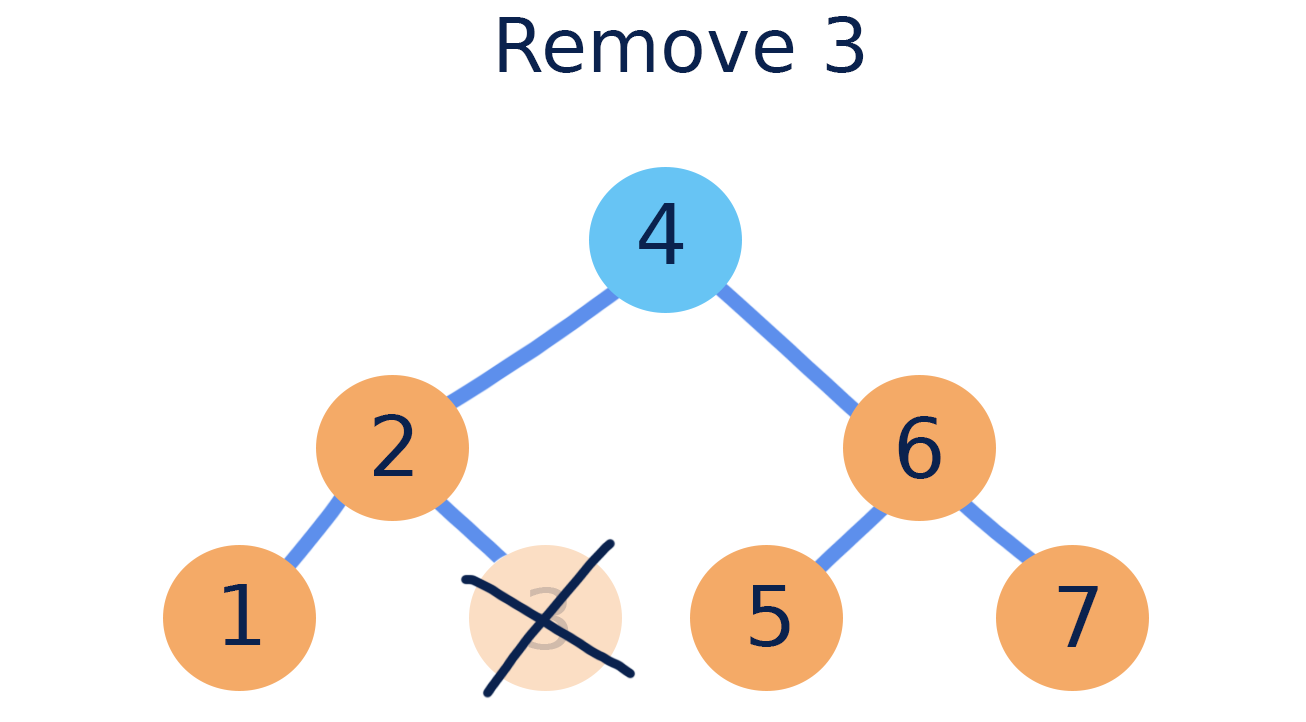
Case 1: Delete a Leaf (Node with no children)
Just remove it. Example: Delete 3.
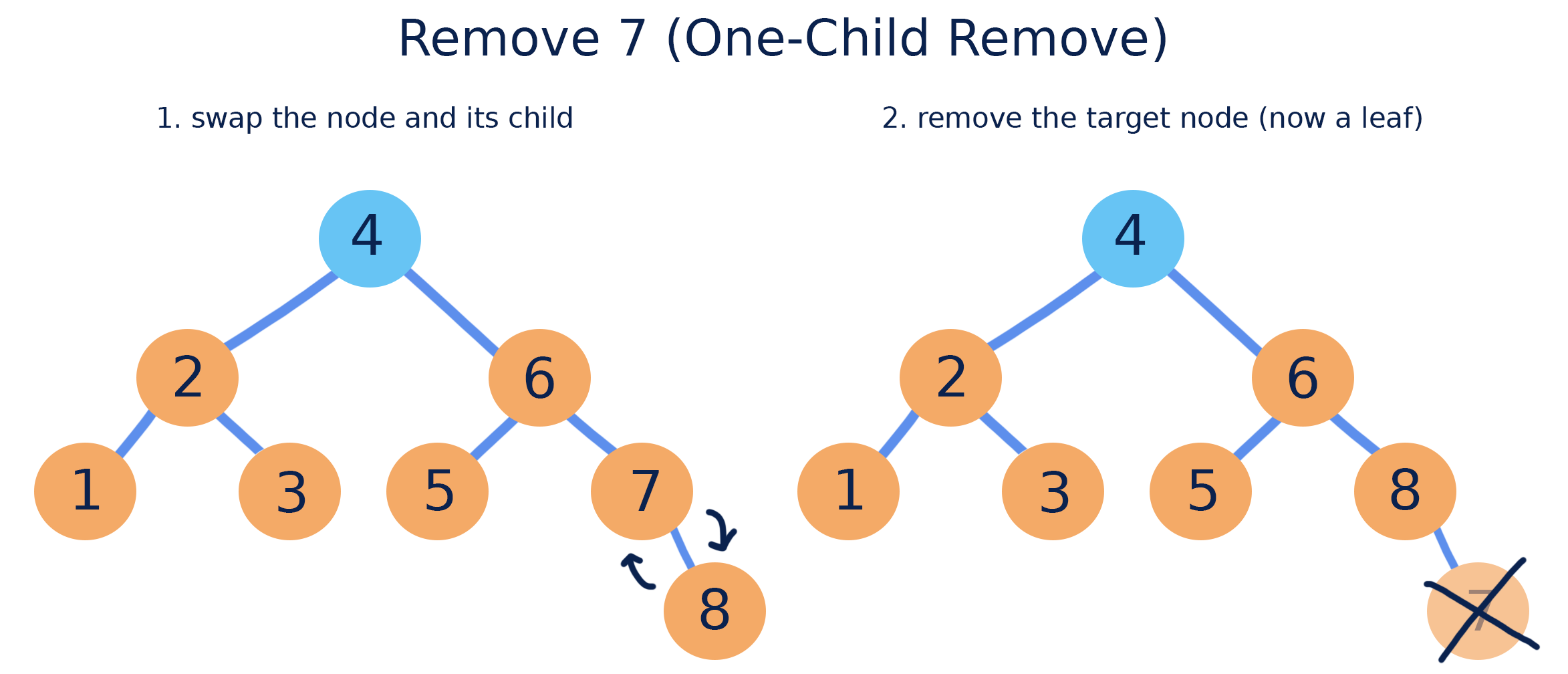
Case 2: Delete a Node with One Child The child moves up to take the parent's place.
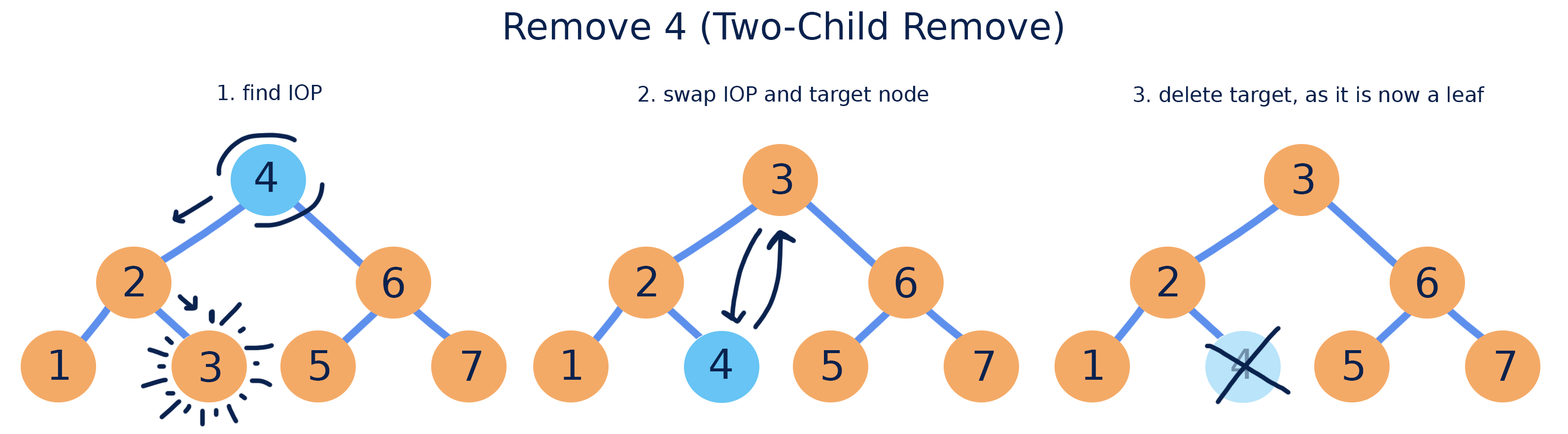
Case 3: Delete a Node with Two Children Find the In-Order Successor (the smallest value in the right subtree, or the largest value on the left subtree). Swap it with the node you want to delete, then delete the successor's original spot.
3) Tree Traversals
Traversal is how we "visit" every node. The order determines what the output looks like.
| Traversal | Order | Common Use |
|---|---|---|
| In-Order | Left → Root → Right | Extracting data in Sorted Order. |
| Pre-Order | Root → Left → Right | Cloning or serializing a tree. |
| Post-Order | Left → Right → Root | Deleting a tree (bottom-up). |
Example Trace:
* In-Order:5, 10, 15 (Ascending) * Pre-Order: 10, 5, 15 (Root first) * Post-Order: 5, 15, 10 (Root last) 4) The Balancing Problem (Skewed Trees)
A BST is only efficient if it is "balanced" (bushy). If you insert data that is already sorted (e.g., 1, 2, 3, 4, 5), the tree becomes a Skewed Tree.
The "Stick" Problem:
The Result: * Search time drops from $O(\log n)$ to $O(n)$.
- You are effectively using a Linked List with extra overhead.
- The Fix: Real systems use Self-Balancing Trees (like AVL or Red-Black trees) that "rotate" the nodes to keep the height minimal.
5) Summary Table
| Operation | Average (Balanced) | Worst Case (Skewed) |
|---|---|---|
| Search | $O(\log n)$ | $O(n)$ |
| Insert | $O(\log n)$ | $O(n)$ |
| Delete | $O(\log n)$ | $O(n)$ |
| Space | $O(n)$ | $O(n)$ |
Student Tip
If you are asked to "Sort" an array using a tree, you are effectively inserting all elements into a BST and then performing an In-Order Traversal. Because the BST property forces smaller values to the left and larger to the right, walking the tree in the Left → Root → Right sequence naturally extracts the data in perfectly ascending order.
5) Summary & Efficiency
In a perfect world, your tree is balanced and your operations are lightning fast. In the real world, the efficiency of your BST depends entirely on its height.
Operation Complexity
| Operation | Average Case (Balanced) | Worst Case (Skewed) | Why? |
|---|---|---|---|
| Search / Access | $O(\log n)$ | $O(n)$ | In a skewed tree, you are just searching a list. |
| Insert | $O(\log n)$ | $O(n)$ | You must search for the correct leaf spot first. |
| Delete | $O(\log n)$ | $O(n)$ | Requires searching for the node and its successor. |
Key Takeaways
- The BST Property: Left < Root < Right. If this is broken at any node, the whole structure fails as a Search Tree.
- Access vs. Search: Remember that trees do not have indices. To "access" the 5th element, you must search for it.
- Traversals: * In-Order: Sorted output.
- Pre-Order: Top-down (good for cloning).
- Post-Order: Bottom-up (good for clearing memory).
- Shape Matters: If your tree looks like a stick, your code will run slow.
Remember: In a tree, roots come first, just like in life